

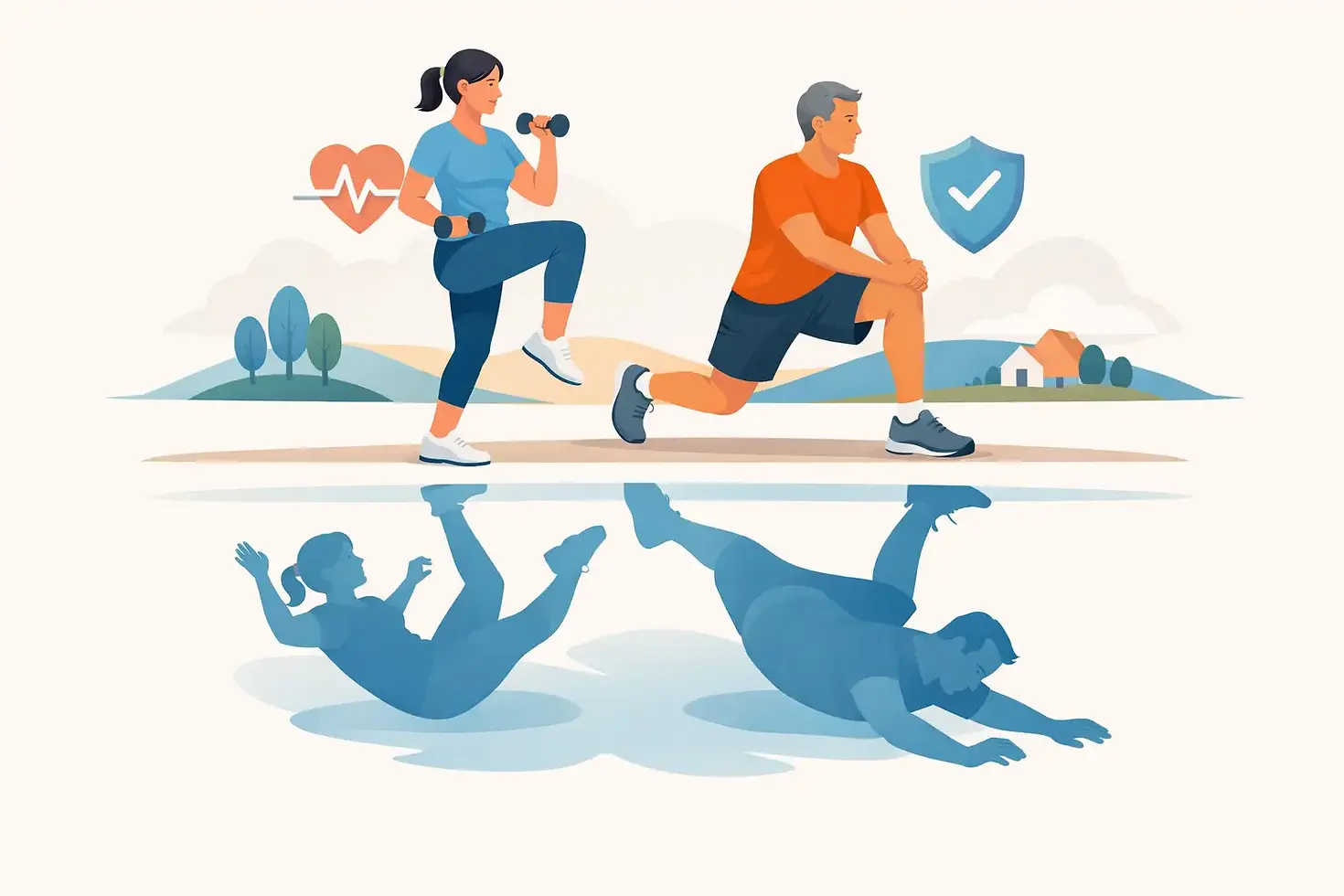
Does Exercise Reduce Fall Risk After 40?

A fall is rarely caused by one missed step alone. It is often the visible result of quieter changes that have been building for years: weaker legs, slower reactions, stiff ankles, reduced vision, medication effects, or growing hesitation when moving. So, does exercise reduce fall risk? For most adults, especially from midlife onward, the evidence-supported answer is yes - when exercise is specific, progressive, and matched to the person.
The key word is specific. Walking more is valuable for heart health and general activity, but it does not automatically train the strength, balance reactions, and confidence needed to recover from a trip, turn safely, or step off a curb. Fall prevention requires a more deliberate plan.
Does exercise reduce fall risk? Yes, but not every program does
Falls become more common with age, yet they should never be dismissed as an unavoidable part of getting older. Exercise can address several modifiable contributors at once: lower-body weakness, poor balance, reduced joint mobility, slow gait, and fear of falling. Better physical capacity gives you more options when the unexpected happens.
Imagine catching your toe on an uneven surface. Your body must recognize the disturbance, shift weight quickly, take a corrective step, and produce enough force through the hips and legs to regain control. That is not one skill. It is a coordinated response involving strength, balance, mobility, reaction speed, and nervous-system practice.
Research consistently supports multicomponent exercise programs for reducing falls among older adults. Programs that combine balance work with functional strength training tend to be more effective than exercise that focuses on only one quality. The trade-off is that a program must be progressed carefully. Exercises that are too easy will not create meaningful adaptation; exercises that are too advanced can be unsafe for someone with pain, dizziness, neuropathy, severe osteoporosis, or a recent fall.
The physical qualities that protect you from a fall
Leg and hip strength
Strong legs are not about lifting the heaviest possible weight. They are about being able to rise from a chair without using your hands, climb stairs with control, carry groceries, and take a quick stabilizing step when needed.
The muscles around the hips, thighs, calves, and trunk all matter. Weak hip muscles can make side-to-side control less stable. Weak quadriceps can make stairs and chair transfers harder. Reduced calf strength affects walking push-off and the ability to respond when the body moves forward unexpectedly.
Useful training commonly includes squats or sit-to-stands, step-ups, controlled split-stance exercises, hip strengthening, calf raises, and loaded carries. The starting point depends on the individual. A person with knee arthritis may begin with a higher chair and supported movements. Someone already active may need progressive resistance and more demanding single-leg work to keep improving.
Balance that is practiced, not assumed
Balance is task-specific. Being able to stand on one leg while holding a countertop is useful, but it does not fully prepare you for turning your head while walking, stepping over an obstacle, or carrying something while changing direction.
Effective balance training gradually changes the demands. It may start with a stable support nearby, a narrower stance, and slow weight shifts. Over time, it can include tandem standing, single-leg balance, stepping in different directions, controlled turns, obstacle negotiation, and carefully supervised dual-task work. The goal is not to perform risky tricks. It is to build reliable control in situations that resemble daily life.
A program should make balance challenging enough that you must pay attention, while remaining safe enough that a handhold, wall, rail, or coach is available. Removing support too early is not brave training. It is poor risk management.
Mobility where it changes movement
Limited ankle motion can affect walking and stair descent. Stiff hips may shorten stride length and make turns awkward. Thoracic stiffness can reduce posture and awareness of the environment. Mobility work has value when it improves the movement you actually need.
This does not require long, aggressive stretching sessions. Controlled ankle movements, hip mobility drills, reaching patterns, and strength exercises performed through an appropriate range can be more useful than forcing flexibility. If joint pain increases or lingers after training, the exercise selection, range, load, or technique needs review.
Gait, coordination, and confidence
Many falls occur during ordinary movement: walking while distracted, getting up at night, turning too fast, or stepping around clutter. Practicing walking mechanics, purposeful stepping, changes of direction, and controlled transitions can improve coordination.
Confidence also matters. After one fall or near-fall, many people start moving more cautiously. This can seem sensible, but excessive avoidance often leads to less activity, weaker muscles, and poorer balance - increasing risk over time. Well-designed exercise rebuilds confidence through successful, repeatable experiences rather than false reassurance.
What a practical fall-prevention routine can include
For adults who have been medically cleared to exercise, a well-rounded week may include strength training on two or more days, balance practice on most days, regular walking or cardiovascular exercise, and mobility integrated into the warm-up and strength work. The exact dose depends on health status and baseline ability.
A useful session does not need to be complicated. It may include a sit-to-stand or squat variation, step-ups, a hip-strengthening movement, calf raises, a pulling exercise for posture, and several minutes of progressive balance practice. Quality matters more than rushing through repetitions.
The following principles make the work more effective:
Train movements that resemble daily demands, including standing up, stepping, climbing, carrying, and turning.
Progress gradually by adjusting resistance, range of motion, support, speed, or complexity - not by sacrificing control.
Practice balance frequently, because the nervous system responds to regular exposure.
Include recovery, sleep, hydration, and adequate protein, since fatigue and poor nutrition can affect strength and coordination.
For many adults over 40, one major mistake is waiting until balance feels noticeably poor before starting. By then, strength and mobility may already have declined. Prevention is easier when it begins while you are still active enough to train confidently.
Exercise is powerful, but it is not the only fall-risk factor
A responsible answer to whether exercise reduces fall risk must include the limits. Training cannot correct every cause of falling. Medication side effects, low blood pressure, vision changes, inner-ear disorders, foot pain, unsafe footwear, alcohol use, poor lighting, loose rugs, and cluttered walkways can all contribute.
If you have fallen more than once, fainted, experienced new dizziness, noticed sudden weakness, or feel unsteady without a clear reason, do not simply add harder balance drills at home. Seek medical assessment. A clinician may need to review medications, cardiovascular issues, neurological symptoms, vision, bone health, or other underlying factors.
This is especially important for people with osteoporosis or osteopenia, diabetes-related neuropathy, Parkinson's disease, stroke history, significant arthritis, recent surgery, or chronic pain. Exercise remains highly valuable in many of these situations, but the plan must respect condition-specific precautions. For example, a person with neuropathy may need greater attention to footwear, foot checks, stable surfaces, and external support. Someone with severe osteoporosis may need guidance on spinal loading and movement choices.
Why professional programming can make the difference
Generic online workouts often treat balance as an afterthought: a few seconds on one foot at the end of class. That is not enough for someone whose independence, confidence, and injury risk are at stake.
A qualified coach should assess how you stand from a chair, walk, turn, step up, balance, and manage load. They should also ask about pain, previous falls, medical conditions, medications, and the activities you want to keep doing. From there, exercise can be progressed with a clear purpose rather than copied from a younger person's program.
At Fitness Tutor, this medical-informed approach is central to training adults who want to stay capable, mobile, and independent. The aim is not gym performance for its own sake. It is the ability to travel, work, play with grandchildren, use stairs, and move through life with more control.
A fall can change a person's life quickly, but prevention is built gradually. Start with the movements you need every day, train them consistently, and get expert guidance when pain, health conditions, or uncertainty make self-directed exercise a poor gamble. The best time to improve your balance and strength is while you still have the freedom to practice them.
Comments