

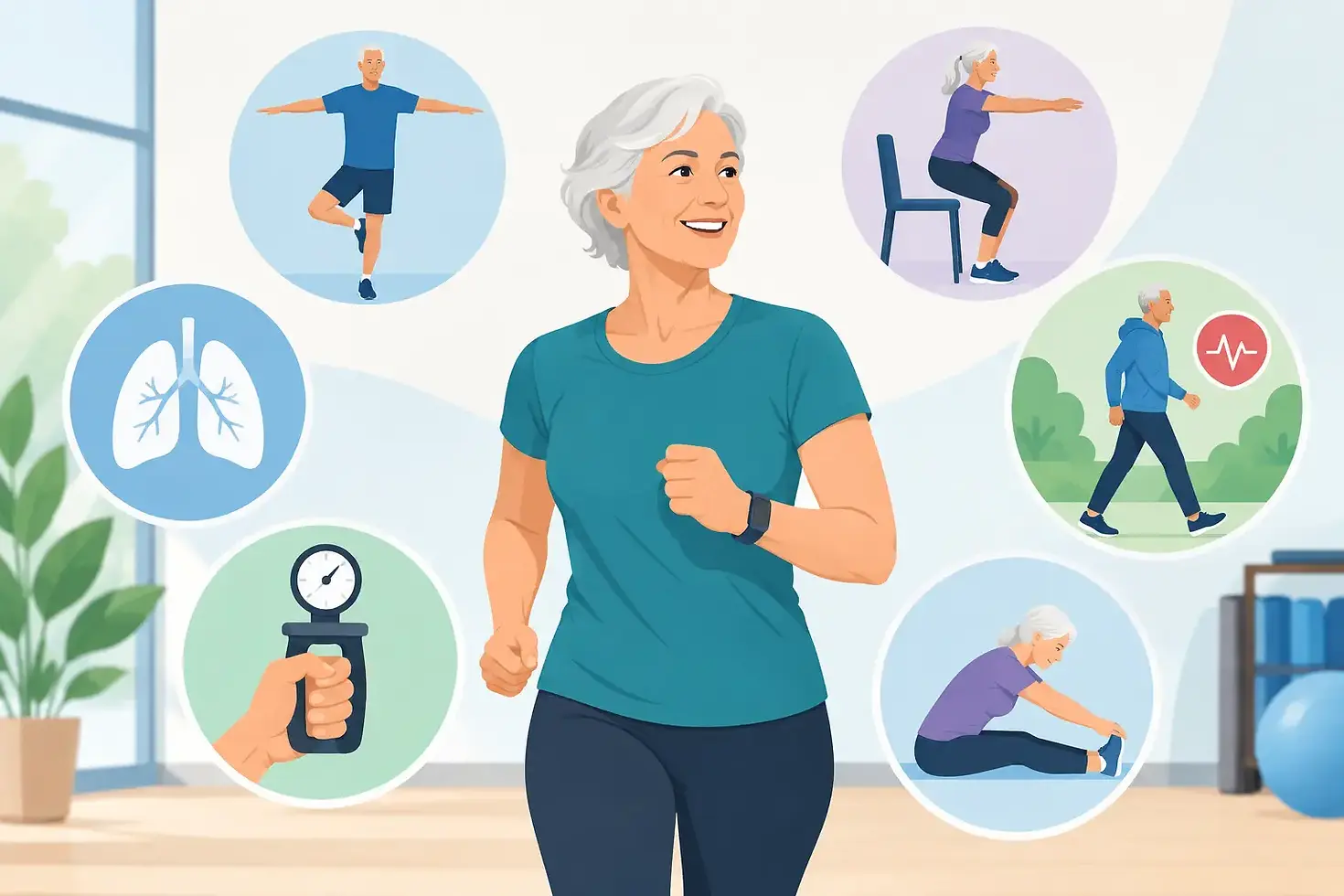
7 Best Fitness Tests After 60 That Matter Most

A flight of stairs, a low chair, and a busy crosswalk can reveal more about your fitness than a bathroom scale ever will. The best fitness tests after 60 are not designed to impress anyone at the gym. They measure the physical capacities that protect independence: leg strength, walking ability, balance, mobility, and cardiovascular endurance.
For adults over 60, testing should never be a reckless attempt to prove you are still young. It is a structured way to identify where your body is capable, where it is vulnerable, and what needs attention before a small limitation becomes a fall, injury, or loss of confidence. The right assessment gives you a baseline, then helps guide training that is safe enough to sustain and challenging enough to produce change.
Why Fitness Testing Changes After 60
After 60, fitness becomes increasingly specific. Someone may still enjoy walking but struggle to rise from a chair without using their hands. Another person may have strong legs but poor balance after a medication change, arthritis flare, or prolonged period of inactivity. A generic exercise plan can miss these differences.
Age alone does not determine ability. Medical history, previous injuries, bone density, blood pressure, diabetes, joint health, sleep, and current activity level all matter. That is why a test result should be interpreted in context, not treated as a diagnosis or a pass-fail verdict.
A qualified coach should also know when not to test. New chest discomfort, unexplained shortness of breath, dizziness, unstable blood pressure, recent surgery, an acute injury, or poorly controlled chronic disease may require medical clearance first. Pushing through warning signs is not discipline. It is poor risk management.
The 7 Best Fitness Tests After 60
1. The 30-Second Chair Stand Test
This is one of the most useful lower-body strength tests for older adults because it mirrors a daily requirement: standing up from a chair. Sit in a stable, armless chair with feet flat on the floor and arms crossed over your chest if that is safe. Count how many full stands you can complete in 30 seconds.
The chair stand reflects strength and endurance in the quadriceps, glutes, and trunk. A low result can indicate that stairs, getting up from the toilet, or recovering from a stumble may be harder than they need to be. It can also highlight a training opportunity. Squat variations, step-ups, split squats, and progressive resistance training can improve this capacity substantially when programmed correctly.
If crossing the arms is not appropriate because of balance, shoulder pain, or deconditioning, using the hands is acceptable for the first assessment. Record that modification so future results are compared fairly.
2. Timed Up and Go
The Timed Up and Go, often called the TUG, assesses practical mobility. From a seated position, stand up, walk 10 feet, turn around, return to the chair, and sit down. The time begins when you are told to go and ends when you are seated again.
This test is valuable because it combines several demands at once: leg strength, walking speed, turning control, coordination, and balance. The turn is particularly informative. Many falls happen while changing direction, navigating a tight space, or trying to move quickly while distracted.
A slow or unsteady TUG does not automatically mean someone is at high fall risk. Footwear, room setup, pain, use of an assistive device, and familiarity with the task all affect performance. However, noticeable instability, grabbing for furniture, or a worsening result over time deserves professional attention.
3. Usual Walking Speed
Walking speed is a remarkably practical health marker. Measure a clear 13-foot or 20-foot course, allow a few steps to get moving, and time the middle portion at your normal pace. Repeat two or three times and use the best or average result consistently.
This is not about racing. Usual gait speed reflects how efficiently the cardiovascular, muscular, nervous, and balance systems work together. It also has obvious real-world relevance. Can you cross a street comfortably before the signal changes? Can you keep up with family during an outing without fatigue or fear of falling behind?
When walking speed declines, the cause may be simple deconditioning. It may also relate to pain, weak hip muscles, reduced ankle mobility, poor footwear, vision changes, or a neurological issue. That is why testing should lead to investigation and a plan, not a vague instruction to walk more.
4. The 6-Minute Walk Test
The 6-minute walk test measures how far you can walk in six minutes on a flat, safe course. It is an accessible assessment of aerobic capacity and walking endurance, especially for people who do not tolerate high-intensity exercise or treadmill testing well.
For a previously sedentary adult, the test can expose a gap between being able to complete daily tasks and having enough reserve for travel, hills, errands, or an active retirement. For someone managing hypertension, diabetes, excess body weight, or cardiovascular risk, it provides a useful baseline for monitoring progress.
This test should be performed in a clear area, with supportive shoes and access to a chair if needed. Stop immediately for chest pressure, severe breathlessness, lightheadedness, or unusual pain. If you have known heart or lung disease, ask your physician or an appropriately qualified exercise professional whether a supervised assessment is more suitable.
5. Single-Leg Balance and Tandem Stance
Balance deserves direct testing because walking alone does not adequately challenge it. For a single-leg balance test, stand near a sturdy counter or wall, lift one foot slightly, and time how long you can hold the position without grabbing support. Test both sides. A tandem stance places one foot directly in front of the other, heel to toe, while holding the position near support.
These are not party tricks. They show how well your feet, ankles, hips, vision, and nervous system coordinate to keep you upright. Side-to-side differences are often as useful as the total time. A large difference may reflect a past injury, hip weakness, ankle stiffness, or a balance strategy worth addressing.
Never perform balance testing alone in the middle of a room. Keep one or two fingers near support and prioritize control over a heroic time. If you cannot safely lift a foot, begin with a narrower standing stance and progress gradually.
6. Grip Strength
Grip strength requires a hand dynamometer, but it is worth including when equipment and qualified interpretation are available. Grip strength is associated with overall muscular strength and can reveal changes that may not be obvious during casual activity.
It is not a complete measure of fitness. Arthritis, hand pain, a previous wrist injury, and certain neurological conditions can lower a score independently of total-body strength. Still, a declining grip score, especially alongside slower walking or reduced chair-stand performance, can signal a need for more comprehensive strength training and medical review.
A good program does not simply prescribe hand squeezes. It builds whole-body strength through appropriately loaded pulling, carrying, pressing, squatting, hinging, and trunk work, while respecting joint limitations and bone health.
7. Sit-and-Reach or Chair Sit-and-Reach
Flexibility is often overemphasized and poorly measured, but specific range of motion still matters. The chair sit-and-reach test is safer and more relevant for many older adults than a floor-based test. Sit toward the front of a chair, extend one leg with the heel down, then reach toward the toes without bouncing or forcing the movement.
The purpose is not to achieve an arbitrary toe-touch standard. It is to identify whether hamstring, calf, hip, or low-back stiffness is interfering with gait, dressing, stepping over obstacles, or exercise technique. Pain during this test is not a flexibility challenge to conquer. It is a reason to stop and assess the source.
How to Use Results Without Misusing Them
The most useful testing schedule is usually every 8 to 12 weeks, not every day. Test under similar conditions: similar footwear, time of day, medication routine, and level of fatigue. Record not only scores but also details such as knee pain, balance confidence, sleep quality, and whether you used your hands on the chair stand.
Look for patterns. If chair stands improve but walking endurance does not, strength training may be working while cardiovascular conditioning needs more attention. If endurance improves but turning remains unstable, balance and mobility work may be the priority. If every score declines suddenly, do not assume you need more intense exercise. Review illness, medication changes, nutrition, stress, and medical concerns first.
The goal is not to chase a number borrowed from someone else your age. The goal is to build enough strength, movement control, and physical reserve for the life you want to keep living. A properly supervised assessment turns that goal into a clear, measurable plan - and gives you a stronger reason to train with purpose tomorrow.
Comments